
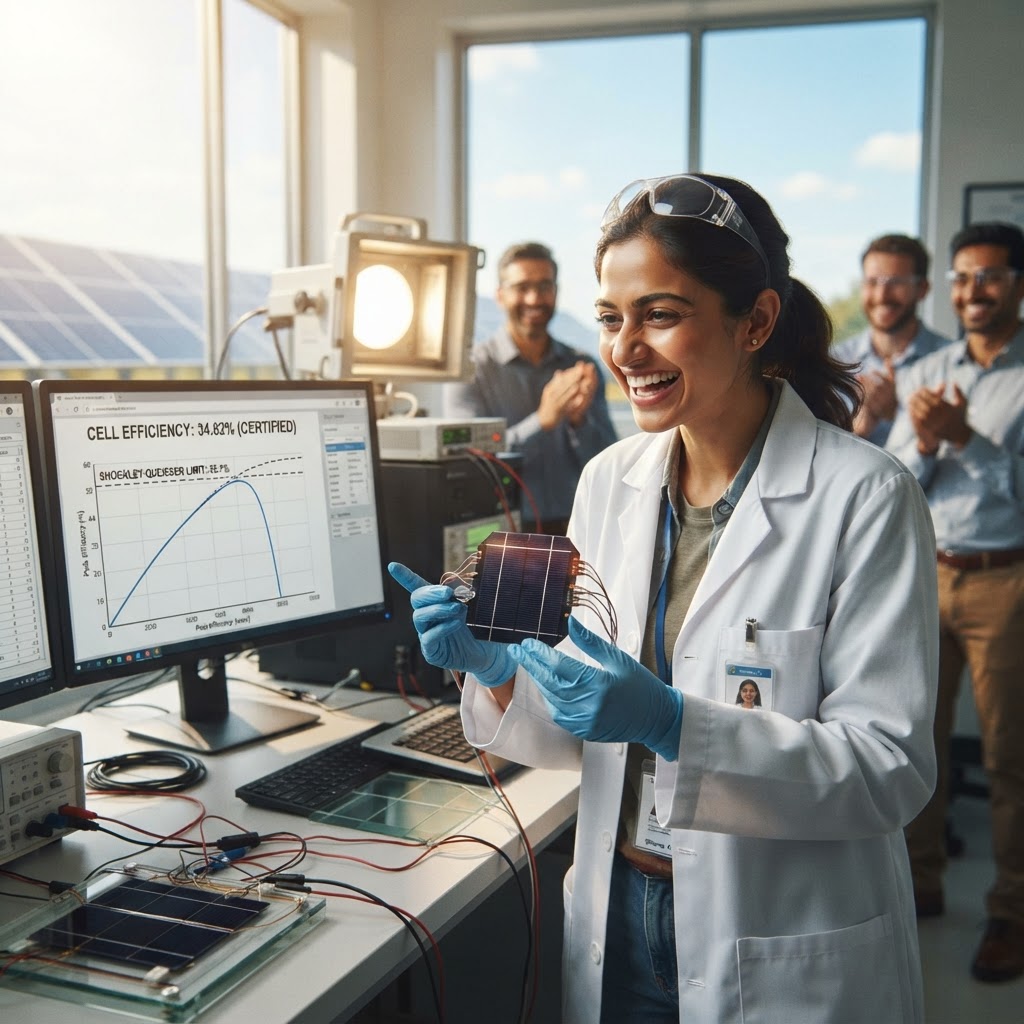
Solar Just Broke Physics: Perovskite-Silicon Tandem Cells Clear the Shockley-Queisser Ceiling at 34.82%
7% — the theoretical maximum efficiency a single-junction silicon solar cell can achieve before thermodynamics says no. Commercial silicon panels have hovered around 24-25% for years. 82% efficiency, verified by the Shanghai Institute of Microsystem and Information Technology (SIMIT) of the Chinese Academy of Sciences. This is JinkoSolar's 33rd world efficiency record.
85%, held by Longi since April 2025. Both numbers are above the single-junction ceiling. That is not a typo.
The mechanism is elegant: a semi-transparent perovskite layer sits on top of a standard silicon cell. The perovskite captures high-energy blue and ultraviolet photons that silicon wastes as heat. The silicon underneath captures the red and infrared light that passes through.
Two absorption windows, one device, more electricity per square meter than either material could produce alone. 06 percentage points over their December 2025 result, which is how records are actually broken in mature technologies: stubbornly, precisely, one decimal place at a time.
5-29% while labs hit 34%. But JinkoSolar's TOPCon bottom cell is already in gigawatt-scale production, which means the manufacturing infrastructure for one half of this tandem is already built. The path from lab record to commercial module is shorter here than for most emerging technologies. Standard silicon panels have essentially plateaued. Perovskite-silicon tandem has not.
The efficiency trajectory alone is why this matters: the fundamental physics argument for why solar cannot scale further is no longer valid.
Original reporting
External source